
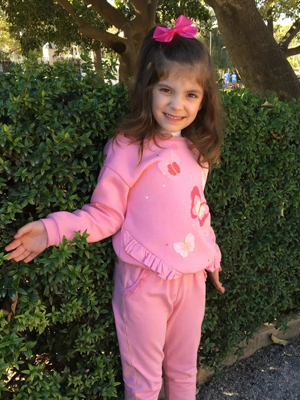
- Year of birth: 2017
- From: Málaga
- Diagnosed: July 2021
- Parents: Mari Carmen and Francis
How would you describe Micaela?
Micaela is a very cheerful, playful and affectionate girl. She is easy to love, and everyone who meets her ends up falling for her personality, because she truly is a very endearing and special girl.
How did we feel when we found out our child has SLC6A1?
For us it was a relief after years of uncertainty and emptiness. It also meant an improvement in the treatment of Micaela’s epilepsy, since having an accurate diagnosis is essential to achieve the most effective treatment possible. For years we did not have that specific diagnosis, which was frustrating because, as it is a rare and underdiagnosed disease, there is a great lack of knowledge and information about it.
How did you know something was wrong?
Micaela was a healthy baby who had no problems of any kind in her first months of life. However, little by little, as she grew, we began to notice that something was not right. She was not reaching developmental milestones normally, but with quite a delay. The “warning signs” that we found worrying began to appear from 12 months. She could not bear her feet touching the floor, she could not stand up, and her legs seemed weak, as if they were made of rag. She also did not like her hands being touched and was clumsy with fine motor skills. There was also a lack of imitation, and her play was that of a baby, centred on putting things in her mouth and little else.
As her public health service paediatrician refused to acknowledge the problem, we decided to seek a second medical opinion. That is how we reached a first diagnosis: hypotonia. However, things got worse when, at 21 months, while Micaela was sitting in her high chair eating, she lost control of her body for a few seconds… it was something strange we had never seen before. These episodes happened again on other occasions, randomly and suddenly, without us being able to find a clear pattern or timing, as they only lasted a few seconds. Her physiotherapist told us about epilepsy and suspected that it might be the cause of these episodes, so she advised us to consult our paediatric neurology service. After a long wait, in May 2019, she was diagnosed with epilepsy. However, it was not until July 2021 that we obtained the definitive diagnosis for Micaela, thanks to Fundación 29 and her current doctor, Dr Ángel Aledo: epileptic encephalopathy due to a mutation in the SLC6A1 gene.
The hardest part of being an SLC6A1 family?
At first, the feeling of loneliness and the lack of support and guidance were overwhelming. We were lost and had no guidance of any kind, so we had to actively look for information and go to private healthcare services. The general lack of knowledge about this rare disease completely overwhelmed us. That is why we believe it is vitally important to set up a patient association to support other families who are going through this difficult situation.
What are your dreams for Micaela?
Micaela has great potential that has not yet been fully developed because of her disease. We are convinced that, if our daughter did not have this condition, she would be a brilliant girl, because even with her difficulties she shows she is exceptional. As parents, our greatest wish is for Micaela to be self-sufficient in the future, able to look after herself without having to depend completely on us. And our biggest dream is to find a cure for her disease. We are 100% convinced that it is possible, and we will fight tirelessly until we achieve it… hence our association’s motto: «Siempre Luchando Contigo» (“Always fighting by your side”, SLC6A1-SPAIN).
Why are donations to SLC6A1 Spain needed?
Help and donations are essential to advance research in search of a cure and to develop the best possible treatment, one that improves our children’s quality of life and is accessible to all families affected by SLC6A1.