
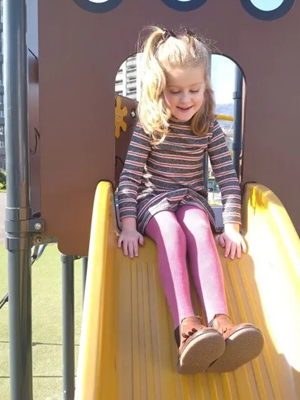
- Year of birth: 2016
- From: Asturias
- Diagnosed: 2020
- Parents: Raquel and Carlos
How would you describe Marta?
Marta is a very bright girl who loves exploring everything. She knows how to enjoy life. She has a great memory and a strong character. Despite the disruptive behaviours she shows, she is the joy of the house, a little dynamo. She loves music and is always humming something.
How did we feel when we found out our child has SLC6A1?
At first we felt relieved, because before we knew the diagnosis she went through lots of genetic tests, MRIs, ultrasounds… all of them negative, so we were living on edge, because we knew something was wrong with our little girl and nobody could find what it was. Afterwards we felt lost, alone and somewhat disappointed, because hardly anything was known about her mutation. Even so, all the therapies she was attending, even before we knew her diagnosis, were on the right track to support her development. Now, thanks to meeting more families who have children with this same mutation, we are more hopeful and encouraged to try, all together, to achieve improvement and, why not, a cure for this disease.
The hardest part of being an SLC6A1 family?
For us, the hardest thing is doing some activities that under normal circumstances would not be a problem: going to the park, going for a walk, going to the doctor, eating at a restaurant, going to school, even with educational support… The disorder associated with this mutation that affects her most is autism and everything that comes with it in terms of social relationships, language development, inappropriate behaviour, etc.
What are your dreams for Marta?
Like any parent of a child with an illness or disability, our dream is for a cure to be found or, failing that, something that can ease the symptoms and associated disorders, such as epilepsy. Meanwhile, our goal is for her to become more and more independent and sociable, and for her language development to allow her to express what is happening to her, what she wants, what she feels, and so on.
What would you say to families who have just learned of the diagnosis?
The first thing I would tell them is that they have been lucky to get the diagnosis. That they are not alone now. That thanks to this association we share experiences that help us a great deal to cope with day-to-day life differently. And together we find solutions to situations or questions that may arise. Together we have created a close-knit group that is very much needed and very rewarding.
Why are donations to SLC6A1 Spain needed?
Donations help fund the study of the disease and support for families. They are essential because, as this is a rare disease, it would be impossible to make progress without them.