
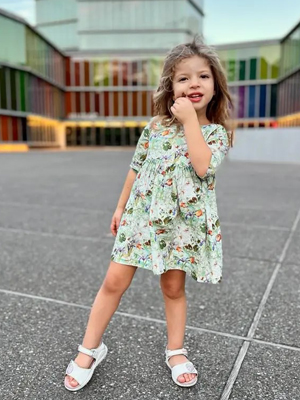
- Year of birth: 2019
- From: Madrid
- Diagnosed: November 2020
- Parents: Celeste and Jordan
- Siblings: Alma
How would you describe Allegria?
Allegria is a girl overflowing with love and joy, living up to her name. She loves music and dancing.
How did we feel when we found out our child has SLC6A1?
Everyone grieves in a different way, even within the same family. When you hear the news, your world falls apart. The first thing you do is search the internet about the disease, which does not help much, until suddenly you find associations like this one, where you can see the reality and the day-to-day life of the disease through families’ own experiences, rather than through medical reports, statistics or diagnoses.
How did you know something was wrong?
When she turned one, we noticed that she was not reaching developmental milestones properly, and she also had stereotypies. We decided to take her to the paediatrician, who referred us to the neurologist, who in turn referred us to the geneticist; months later we had the diagnosis. Allegria did not walk until she was 20 months old and, at 4 years old, she still has no verbal language, although she understands many things.
The hardest part of being an SLC6A1 family?
The difficulty communicating with our daughter and the frustration this causes her. This leads to disruptive behaviour because she does not know how to express what she feels or her emotions. As her cognitive development is slower than that of other children, the gap between her mental and physical age makes everything more complicated. And the uncertainty of not knowing how the disease will evolve.
What are your dreams for Allegria?
That she has a happy, independent and fulfilling life and finds a goal in which she feels fulfilled. We hope that research and better treatments will help her with this.
What would you say to families who have just learned of the diagnosis?
Stay strong. Finding out that your child has a rare disease is a long and painful process. We all hope our children will be healthy, but time and acceptance of the disease mean that, little by little, everything becomes more normal. Do not hesitate to ask for help. In this association you will find the support, experience and advice of other parents who have already been through it. Living with a rare disease is a long-distance race.
Why are donations to SLC6A1 Spain needed?
Donations help fund the study of the disease and support for families.