
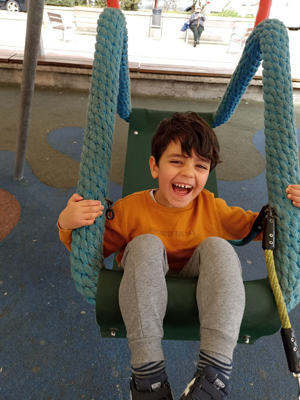
- Year of birth: 2018
- From: Bizkaia
- Diagnosed: September 2019
- Parents: Andrés and Laura
- Siblings: Izan and Luka
How would you describe Hugo?
Hugo is a boy full of energy, although that means being on a kind of rollercoaster: one moment you see him happy and cheerful, the next he gets frustrated and cannot control his impulses and emotions.
He is very affectionate and needs to feel our hugs and kisses all the time. He loves music and spending all his time with us.
How did we feel when we found out our child has SLC6A1?
The beginning was incredibly hard. You have to come to terms with a diagnosis that is also one of the so-called rare ones, with very little information available. We felt that our life plans were crumbling in front of us, and we felt enormous frustration. But little by little we have come to understand our son. We are trying to face each day and walk hand in hand along this SLC6A1 path, and although there are days when you feel you are drifting, meeting other families who feel the same as you has been a real boost and gives us the strength to keep fighting for them, in search of a cure that we hope will come soon.
How did you know something was wrong?
At around 4 months old, and given that we were not first-time parents because Hugo is our middle child, we could not help noticing that he was not reaching the developmental milestones for his age: he did not roll over, he could not sit up, he made no sounds, he did not use his hands to bring them to his mouth or to grab objects, and he did not pay attention when we spoke to him or turn towards us when we talked to him.
At his 6-month check-up, although the paediatrician noticed that he was not reaching the developmental milestones, he told us the phrase that still echoes in our ears: “every child learns at their own pace”, and we chose not to make more of it; it was better to think that everything was fine, although something inside kept us on alert until the next check-up at 9 months, and that is when all the alarm bells went off. We were referred to paediatric neurology and to ENT (to rule out a possible hearing impairment), and after several tests and two genetic analyses (the first to rule out possible Rett syndrome) we received the diagnosis: epileptic encephalopathy due to a mutation in the SLC6A1 gene, with a possibly pathogenic, de novo variant.
The hardest part of being an SLC6A1 family?
The hardest part is precisely getting up every morning without knowing what the day will bring. The disease keeps him constantly on a rollercoaster where regulation is very difficult, and it pulls all of us into that spiral of ups and downs. It is not easy to cope with a child who cannot speak even though he has an enormous need to communicate (and that frustrates him), who is completely dependent for everything, who goes from laughter to tears in the blink of an eye, who constantly has to deal with fears, insecurities and frustrations, and who is very overexcited all day long.
What are your dreams for Hugo?
Above all, that he is happy, and that we manage to help him become as independent as possible and achieve whatever he sets out to do. Hearing him talk would be wonderful, but finding a communication system that lets him express his needs, interests and emotions would be a real achievement. The road will be long and probably difficult, but we are never going to throw in the towel. We are going to find the cure that wakes us from this nightmare! Or at least, we are going to try.
What would you say to families who have just learned of the diagnosis?
That even though it may seem their world is falling apart (nothing could be further from the truth), and even though everything looks bleak at first, they are not alone. Here we are, a group of families who also suffered, who felt anger, fear, frustration and even guilt when we received the diagnosis, and who also felt our world was ending. We will help them through the whole process and they will never feel alone. Together we will achieve the best for our children.
Why are donations to SLC6A1 Spain needed?
Donations are not just needed, they are ESSENTIAL, because without your support we cannot raise awareness of the disease or look for treatments that improve our children’s quality of life (and who knows whether one day we will achieve a gene therapy that solves the problem; that is our number one goal).
Because SLC6A1 is a rare disease, yes, but together we have to make it visible, and for that, social awareness and above all your help are vital. Without funds there are no research options, and without research there is no possibility of a cure.