
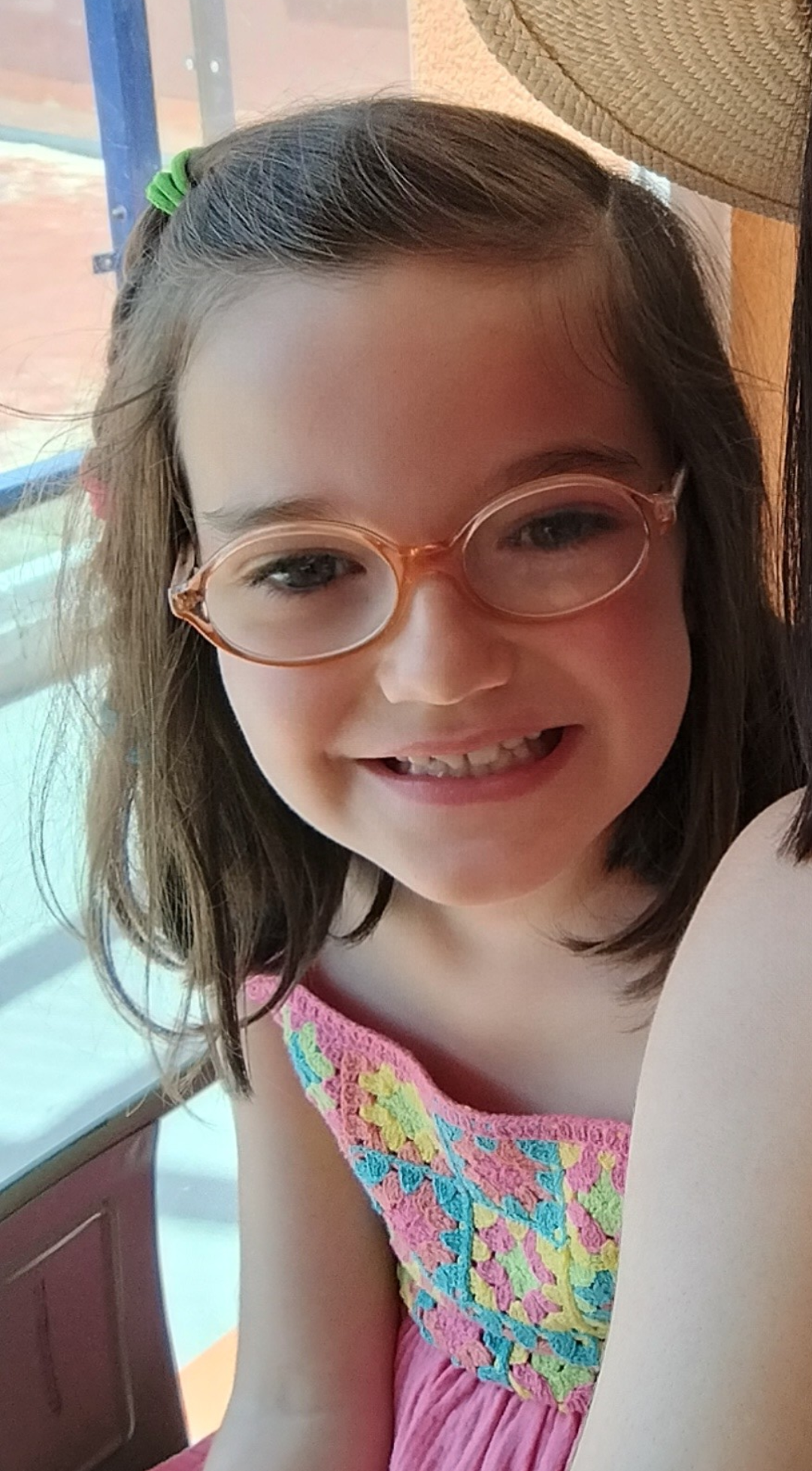
- Year of birth: 2016
- From: Seville
- Diagnosed: October 2023
- Parents: Manuel and Macarena
- Siblings: none
How would you describe your daughter?
Isabel is, above all, a happy girl. She is friendly and very affectionate with the people close to her. She is very innocent and has a pure smile. She can hold conversations and talk about her experiences, and she speaks quite clearly, but she cannot tell whether she has told you something once, three times or not at all. She finds learning difficult and forgets many things. When she is happy she has many stereotypies that she does not control and is not aware of. She is a hard-working girl who wants to learn. Very willing.
How did we feel when we found out our child has SLC6A1?
On the one hand, it was a relief to put a name to what we had been looking for; on the other, it confirmed our worst suspicion: that this was not going to be easy to solve and would not simply pass with the years.
How did you know something was wrong?
From when she was a baby, we saw that she was slower. She did not lift her head when expected, did not roll over, did not do the typical clapping, was not ticklish, her pain threshold was astonishingly high, she was very clumsy in her coordination, and it took her a long time to crawl and learn to walk. She would fall unexpectedly; at other times she lost her balance and her legs were left trembling… Something did not add up…
The paediatrician said she was slow but was reaching the developmental milestones. But on top of that there were stereotypies and difficulty learning colours or the names of family members, so at the age of 2 we decided to find out for ourselves what was going on. We took her to a private assessment centre, and with that assessment we started to take action. At first it was just a developmental delay that would improve.
The hardest part of being an SLC6A1 family?
How little information there is. It is a mutation that has only been known for a very short time, so there is very little information, and there are no known cases of adults to help us understand how it may evolve.
What are your dreams for Isabel?
Our dream is for her to have a full life. For her to learn to read and write, and to be able to have a job one day that allows her to be as independent as possible. But above all, for her to be happy.
Why are donations to SLC6A1 Spain needed?
We need to find something that improves our children’s lives, that reduces their epileptic activity so they can learn to talk, read and write, and that allows them to communicate… Something that brings them closer to what we understand as a normal life.